---
title: 'Cryptography 101: Homomorphisms and Isomorphisms'
description: >-
A deeper dive into core concepts of groups, and a fascinating application:
homomorphic encryption
author: Frank Mangone
date: '2024-04-16'
lang: en
series: cryptography-101
tags:
- cryptography
- encryption
- homomorphisms
- isomorphisms
- mathematics
url: 'https://arkana.blog/en/blog/cryptography-101/homomorphisms-and-isomorphisms/'
---
# Cryptography 101: Homomorphisms and Isomorphisms
> This is part of a larger series of articles about cryptography. If this is the first article you come across, I strongly recommend starting from the [beginning of the series](https://arkana.blog/en/blog/cryptography-101/where-to-start).
So far, our basic understanding of [groups](https://arkana.blog/en/blog/cryptography-101/where-to-start#groups) has proven useful enough to design cryptographic schemes that accommodate to a lot of needs - [encryption](https://arkana.blog/en/blog/cryptography-101/encryption-and-digital-signatures#encryption), [signatures](https://arkana.blog/en/blog/cryptography-101/encryption-and-digital-signatures#digital-signatures), (and some [exotic variants](https://arkana.blog/en/blog/cryptography-101/signatures-recharged)), [proofs](https://arkana.blog/en/blog/cryptography-101/protocols-galore#zero-knowledge-proofs), [commitments](https://arkana.blog/en/blog/cryptography-101/protocols-galore#commitment-schemes), [verifiable randomness](https://arkana.blog/en/blog/cryptography-101/protocols-galore#verifiable-random-functions), etc.
I believe the time is ripe for us to further our understanding of group structures a bit, and while doing so, uncover a new set of **cool cryptographic primitives**.
You may have heard about **homomorphisms** and **isomorphisms** already. But what are these funny-named things, anyway?
---
## Homomorphisms in a Nutshell
In general, a homomorphism is a **function** or **map** that preserves **algebraic properties**.
Recall that when working with groups, we only have a **set** and an **operation**. So a **group homomorphism** really maps elements of one group to **another group**, where the **properties** of the operation are **preserved**.
All this mumbo-jumbo can be reduced to this: if **a** and **b** are elements of a group, then an homomorphism **f** should behave like this:
$$
f(a+b) = f(a) + f(b)
$$
A great example of an homomorphism happens when we take an **elliptic curve group** with generator $G$ and order $n$, and the **additive group of integers modulo** $n$. And we just define:
$$
f: \mathbb{Z}_n \rightarrow \langle G \rangle \ / \ f(x) = [x]G
$$
We can easily see that addition is preserved:
$$
f(a) + f(b) = [a]G + [b]G = [a + b]G = f(a + b)
$$
### Isomorphisms
Notice that in the case above, there's a one-to-one correspondence between elements of both groups. This need **not** always be the case: if we had chosen the integers modulo $q$ instead, with $q > n$, then **at least two integers** would share the same functional value.
In the case that there **is** in fact a one-to-one correspondence, then in theory we could use $f$ to map $\mathbb{Z}_n$ to $\langle G \rangle$, and its **inverse** $f^{-1}$ to map $\langle G \rangle$ to $\mathbb{Z}_n$.
> In mathematical terms, this means that f is a [bijection](https://en.wikipedia.org/wiki/Bijection). You know, just in case you want to be more precise about it!
When this happens, we say that $f$ is an **isomorphism** instead of an homomorphism. And the groups are said to be **isomorphic**.
For all we care in terms of group theory, isomorphic groups are essentially the same group **in disguise**, for we can find a function that lets us transform one group into the other, and vice versa.
### Why Should I Care?
Ah, the million-dollar question.
The idea of groups being homomorphic or isomorphic is very interesting, because moving back and forth from the chosen groups means that we can perform operations in **either of them**. And this allows us to do **some magic**. We'll see that in action in a minute.
Before jumping into an example though, I want to clarify some notation you may come across. If you check for instance [this page](https://en.wikipedia.org/wiki/ElGamal_encryption) on ElGamal's cryptosystem (an algorithm we'll look at in just a minute), you'll notice that they don't seem to use **addition** when working with groups. Instead, they use **multiplication**, and **exponential notation**:
$$
y = g^x
$$
Huh. This doesn't resemble our previous examples. How so?
The key to understand this is to see things under the lens of **isomorphism**. Take a look at these two groups:
$$
\mathbb{Z}_5 = \{0, 1, 2, 3, 4\}
$$
$$
G_5 = \{1, g, g^2, g^3, g^4\}
$$
If we just grab pen and paper and match element by element, we can clearly see that there's a one-to-one correspondence. Formally, the relation has the form:
$$
f(x) = g^x
$$
We say that the second group is **multiplicative** - notice that addition of elements in $\mathbb{Z}_5$ is replaced by multiplication of elements in $G_5$:
$$
f(a + b) = g^{a+b} = g^a.g^b = f(a).f(b)
$$
This is totally acceptable, since the operations in both groups are **not necessarily** the same.
> So yeah, if you ever see the multiplicative notation while looking at a group-based system, bear in mind that an additive version can also probably be formulated by means of this isomorphism.
---
## Homomorphic Encryption
Okay, enough formalisms. Let's get to the good stuff.
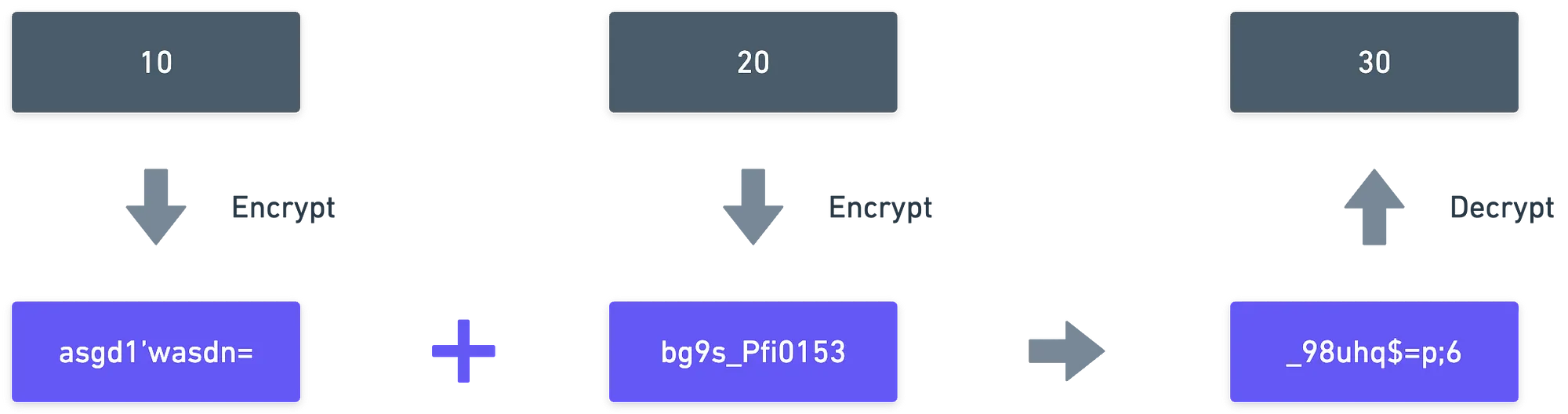
Suppose you want to perform a sum of two integers, modulo $q$. But these numbers are **encrypted**. Normally, you'd have to decrypt both numbers, and add them. And if you want to store the encrypted result, you'd have to **re-encrypt**.
But what if we could **skip the decryption entirely**?
This is exactly the goal of **homomorphic encryption**: performing operations on **protected**, **private data**, but obtaining the same result as one would get by operating with the **plain**, **unprotected data**, and **encrypting** later.
And that's awesome, because we can save ourselves the time of executing decryption operations - which are expensive - , while also preserving privacy of the data.
> In theory, at least. There are some nuances around this, as we'll discuss in a minute. But the privacy part is cool, though!
So, how do we achieve this kind of functionality?
### ElGamal Encryption
This is one of the **simplest cryptosystems** out there. In spite of it's simplicity, the encryption function has a very nice property: it's **homomorphic**!
Thus, we can perform operations of the encrypted data. Let's see how it goes.
As always, we'll start with Alice having a private key $d$, which she uses to calculate a public key $Q = [d]G$. And yeah, $G$ is your typical elliptic curve generator.
Let's say Bob wants to encrypt a message for Alice, knowing her public key $Q$. For this to work, we must assume that the **message** is a **point in the elliptic curve**, $M$. And this can be obtained by passing the original message through a **reversible function** (hashing won't do).
We won't cover how to do that first step now - let's just assume we know how to do it.
Then, Bob follows this procedure to encrypt:
- He chooses a random integer r, and computes $R = [r]G$.
- After that, he calculates a **mask** (as usual) as $[r]Q$.
- Finally, he adds the mask to the message, so $C = M + [r]Q$.
The obtained ciphertext is $(R, C)$. To decrypt, Alice has to:
- Compute $[d]R$, which will be exactly equal to the mask $[r]Q$.
- Subtract the mask from $C$, so $C - [r]Q = M$.
> Since we're being more precise now, we can say that subtracting is really adding the **additive inverse** of the subtracted value. It's just easier to say "subtract".
The encryption part of this process can be expressed as a **function** that takes a message $M$, and some **randomness** $r$, and outputs a **ciphertext**:
$$
\varepsilon: \langle G \rangle \times \mathbb{Z}_q \rightarrow \langle G \rangle \times \langle G \rangle \ / \ \varepsilon(M,r) = ([r]G, M + [r]Q)
$$
And **this** will be our **homomorphism**.
Imagine you encrypt $M_1$ with randomness $r_1$, and $M_2$ with randomness $r_2$. What happens if we **add** the encrypted results?
$$
\varepsilon(M_1, r_1) + \varepsilon(M_2, r_2) = ([r_1]G, M_1+[r_1]Q) + ([r_2]G, M_2+[r_2]Q)
$$
$$
= ([r_1 + r_2]G, M_1+M_2+[r_1 + r_2]Q) = \varepsilon(M_1 + M_2, r_1 + r_2)
$$
And boom! The result is the same as if we had summed the messages (and randomness) first!
Just like magic.
---
## Observations
The scheme presented above is just about as simple as it gets. And although this example is very illustrative, it's not perfect by any means, and there are a thing or two we must say about it.
### Encodable Messages
First, notice that the **message** we can encrypt is related to the **group order**, $n$. Remember that the group order means the **number of elements** in the group, so there's only finitely many ($n$, to be precise) different points in the group.
Since we're required to **reversibly encode** our message to a point $M$, then this means that each point $M$ corresponds to a unique message - so there's only n unique messages we can encode.
And this is, in turn, means that we **cannot encode** a message of **arbitrary length**. We could think of clever strategies to separate a message in "chunks", but this could undermine the homomorphic aspect of our scheme.
But this doesn't mean that the technique has no value - for instance, think of the messages as **private balances**. We could deal with a maximum representable balance, could we not?
### Partial Homomorphism
On the other hand, this homomorphic encryption only supports **one operation**. And this is to be expected, since we're working with **groups**. So if the group operation is addition, then we can't do **multiplication**. And thus, this is known as **Partial Homomorphic Encryption**, or **PHE**.
If we can support both addition **and** multiplication, then our scheme would be **fully homomorphic** - and we would talk about **Fully Homomorphic Encryption**, or **FHE** for short.
Crafting a fully homomorphic encryption scheme is no easy task - and groups **simply won't do**. We'll require a different mathematical structure to tackle this, one that supports **two operations**. When that's our requirement, we need to jump into the domain of [ring theory](https://en.wikipedia.org/wiki/Ring_theory), an endeavor we will pursue [later in the series](https://arkana.blog/en/blog/cryptography-101/rings).
### Zero-Knowledge Proofs
Picture an application with **private balances**. You can decrypt your own balance, but whoever process a transfer request **can't**. Therefore, you need to somehow prove to the processor that you:
- Know your balance, and the amount to transfer
- Have enough balance to cover the transfer
But you need to do this without revealing the values, because the whole point of the application is to **keep balances private**!
In order to do this, we'll need to couple our homomorphic encryption efforts with **Zero-Knowledge Proofs** (**ZKPs**). And generally speaking, ZKPs tend to be computationally expensive - so the benefits of not having to decrypt are somewhat balanced out because of this. Nevertheless, privacy of the data may be required - for instance, homomorphic encryption is an attractive solution for privacy on public networks, such as Blockchains.
---
## Summary
This time around, we went a little deeper into the mathematics, which ultimately allows us to better understand the structures that underly our constructions.
We saw a (partially) homomorphic encryption scheme in action. Of course, ElGamal's is not the only system that has this homomorphism property. Other group-based schemes exist, such as the [Benaloh cryptosystem](https://en.wikipedia.org/wiki/Benaloh_cryptosystem) or the heavily-cited [Paillier cryptosystem](https://en.wikipedia.org/wiki/Paillier_cryptosystem).
We've come a long way. For now, we'll put a stop to our exploration of elliptic curve cryptography (ECC). But this is not the end of the journey, **by any means**. Turns out that elliptic curve groups work very nicely with **another construction** that allows some **very cool cryptography**. We'll get into that [soon](https://arkana.blog/en/blog/cryptography-101/pairings).
However, there's a topic I want to touch on before that: **polynomials**, and the possibilities they offer. This will be the topic for the [next article](https://arkana.blog/en/blog/cryptography-101/polynomials)!