---
title: 'Cryptography 101: Encryption and Digital Signatures'
description: >-
Building upon our previous knowledge of elliptic curves, we explore how to
encrypt and sign information
author: Frank Mangone
date: '2024-03-18'
lang: en
series: cryptography-101
tags:
- cryptography
- ellipticCurves
- mathematics
- encryption
- digitalSignatures
url: >-
https://arkana.blog/en/blog/cryptography-101/encryption-and-digital-signatures/
---
# Cryptography 101: Encryption and Digital Signatures
> This is part of a larger series of articles about cryptography. If this is the first article you come across, I strongly recommend starting from the [beginning of the series](https://arkana.blog/en/blog/cryptography-101/where-to-start).
In the [previous installment](https://arkana.blog/en/blog/cryptography-101/elliptic-curves-somewhat-demystified), we expanded upon our basic knowledge of groups by defining **elliptic curve groups**. And we briefly mentioned that these concepts would allow us to construct some useful cryptographic mechanisms.
And as promised, we'll take a look at **two** such basic technique examples: one for **digital signing**, and one for **encryption**. But before we do this, we need to define a couple gadgets that will be essential in our development. We'll be working in the context of elliptic curves, but these concepts can be generalized to other groups.
You've probably heard of **private** and **public keys**. Let's take a look at what they really are.
---
## Key Pairs
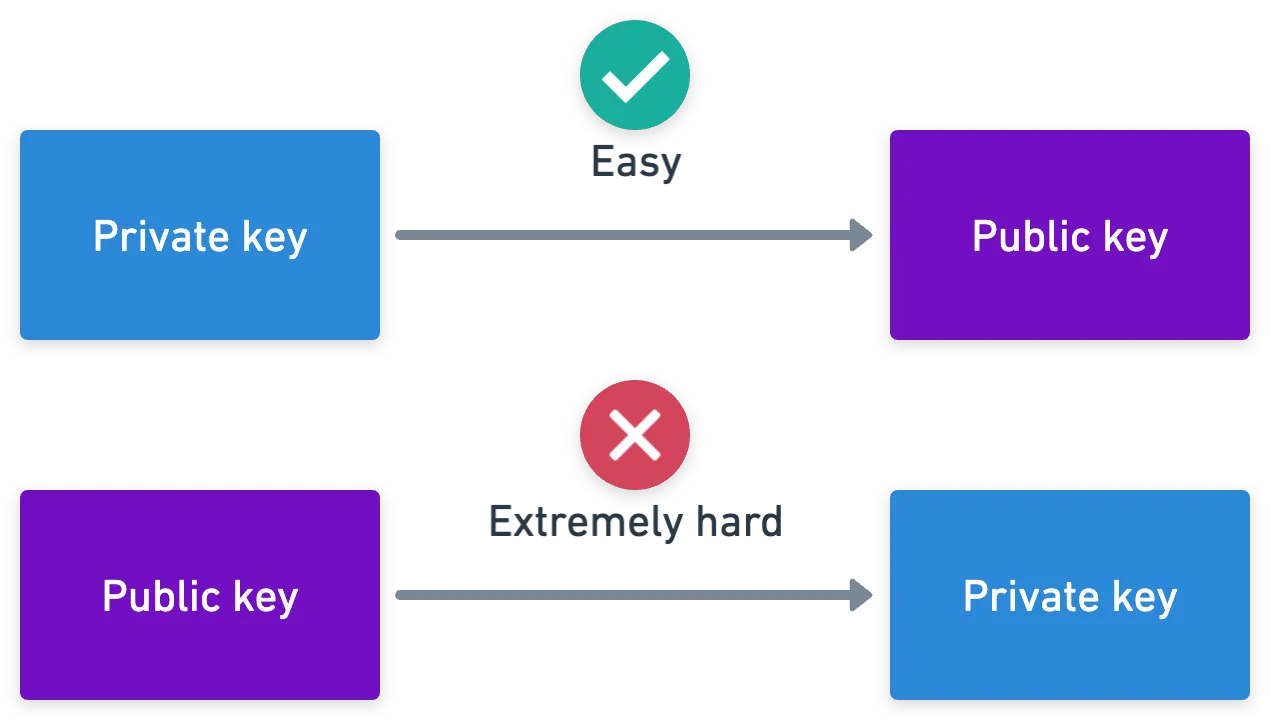
The story that's usually told when learning about digital signatures goes something like this: a user (let's say, Alice) with a private (or **secret**) key can **sign** a message, and then anyone can **verify** the signature with the associated public key.
And of course, we learn **nothing** about the mechanisms behind this. But there's an implicit message in there: it **shouldn't be possible** to get a private key from a public key, for this would mean anyone holding Alice's public key could produce a signature in Alice's name (it's called **private** for a reason, after all). With this to consider, let's see what these keys really are.
> Remember [group generators](https://arkana.blog/en/blog/cryptography-101/where-to-start) from the very first article? Well, this is where they come in. Elliptic curves, being groups, also have generators and subgroups!
Suppose Alice and some other guy Bob agree on a generator point $G$ on the elliptic curve. Alice then chooses some random number $d$ from the set of **integers modulo** $q$, so $d < q$. Also, let's assume $d$ is a big number, not just $12$ or $35$. This will be her **private key**.
Alice proceeds to calculate $Q = [d]G$, leveraging the power of **point doubling**, and obtains **another point** in the group - this will be her **public key**, and she can safely send it out to Bob.
Evidently, $Q$ **encodes information about the private key**. Bob could try and calculate a number $d$ such that $Q = [d]G$ - but the problem is that, if our elliptic curve group is "big enough", that would take Bob a really, **really** long time. And this is **precisely** the secret sauce: finding $d$, even when knowing $Q$ and $G$, should be nearly impossible. This is known as (a version of) the **discrete logarithm problem** (**DLP**).
Of course, if our group happens to have $1000$ elements, or if the number Alice chooses is "small", trying possible values of $d$ is a doable task. You can probably write a script that solves the problem in under 10 minutes - this is called **brute forcing**. The DLP problem really shines when we have **huge** groups. For instance, the [curve 25519](https://en.wikipedia.org/wiki/Curve25519) has subgroups of order around $~2^{250}$. That's quite a big number. Good luck trying to brute-force $d$.
---
## Encryption
Alice now holds some number $d$ as her private key, and Bob holds the corresponding public key $Q$, which is just a point on the elliptic curve. What can they do with this?
These gadgets we developed are just about enough to start building fun things (yay!). Let's **encrypt** some data!
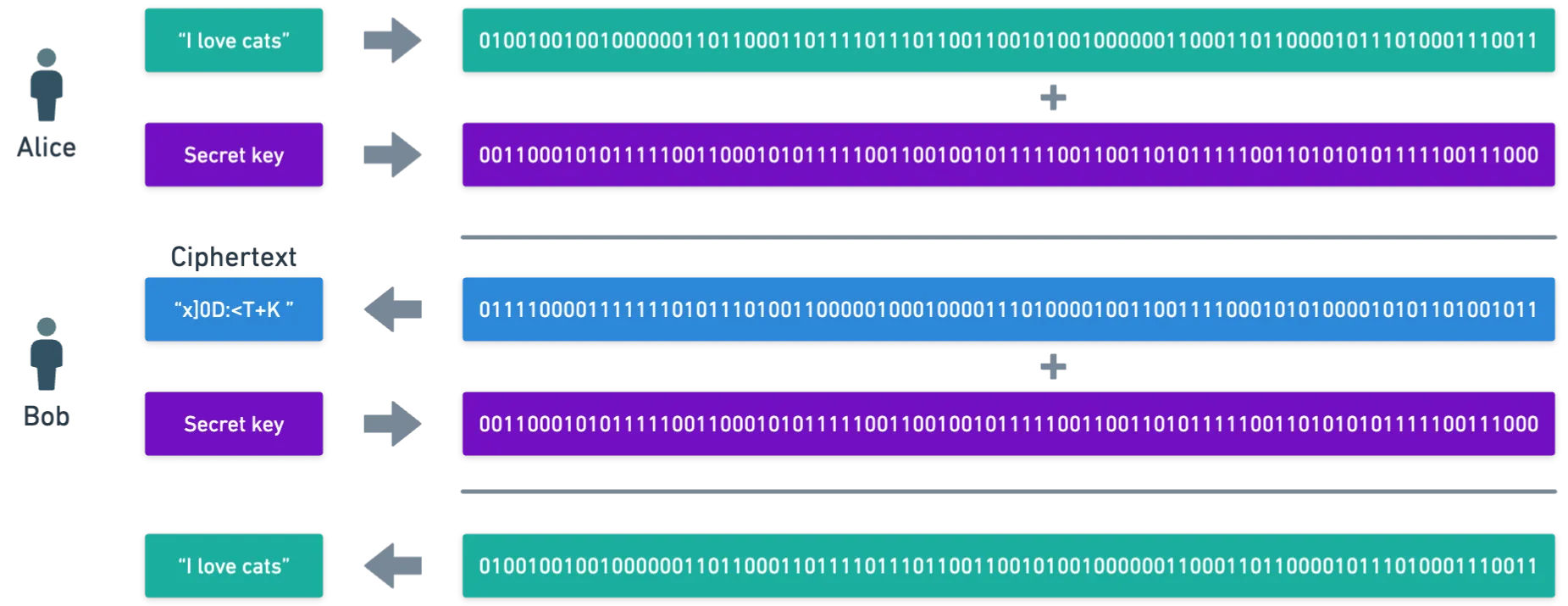
> Imagine that Bob wants to **protect a message** so that Alice is the only person who can read it. If they were teenagers at school, they may exchange a written message in a **secret code** that only Alice and Bob can understand. Since they both know the secret code, both of them can "undo" the encoding - so this is called **symmetric encryption**.
Alright, sounds simple enough!
How does this happen in a **real application**? Think about this: any message is just a bunch of **zeros** and **ones**, some **binary number**. If we **distort** said number, we essentially transform it into meaningless gibberish - this is usually called **ciphertext**. And if we do this in a **reversible** way, the original message can be recovered!
> Here's a [simple implementation](https://gist.github.com/frankmangone/2ec7bff333a8d2ef7138bf0ac1e161d6) in case you want to play around with it.
Just to clarify, the reversibility here is given by the logical XOR operation. Don't worry about this - the point is that we were able to **mask** the original message, with a **shared secret key**.
### What About Elliptic Curves?
Clearly, we **didn't need** elliptic curves in the previous construction. And this goes to show that cryptography is **much broader** than just a single tool, and really dates back to well before elliptic curves were even a thing.
But what happens with the secret key? How do Alice and Bob **agree** on a shared key? If they do this in an insecure way, then someone else could be listening, and that third person (let's say Charlie) can then **read Alice and Bob's secret messages**! Not cool, our encryption is rendered useless!
Let's not panic yet. Even though there are ways to [securely share secret keys](https://en.wikipedia.org/wiki/Diffie%E2%80%93Hellman_key_exchange), there's another way around this: we can use elliptic curves to obtain the shared secret in an **asymmetric way**.
### Asymmetric Encryption
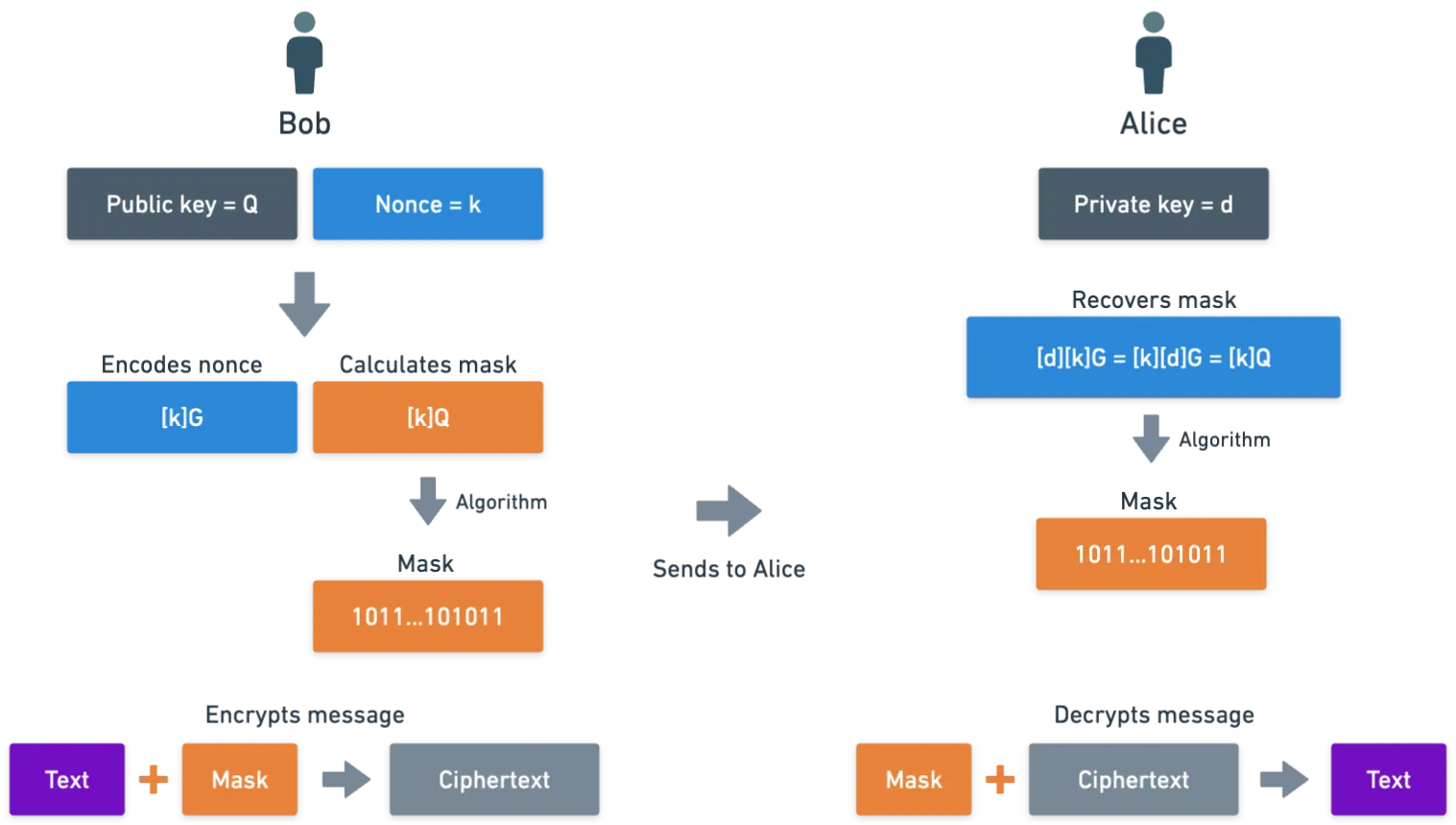
Say Bob wants to encrypt a message $M$ for Alice. Instead of agreeing on a key, Alice can simply choose a private key $d$, and share her public key $Q = [d]G$ with Bob. With this setup, we can devise a way for Bob to encrypt messages for **Alice and Alice only**. This is how it goes:
- He picks some random number $k < q$, usually called a **nonce**,
- Bob then computes $[k]Q$, and uses this to calculate a **mask**, which we'll denote $P$, using some agreed-upon algorithm,
- He masks the message using XOR as in the previous example, and obtains the **ciphertext** $C = M + P$,
- Finally, he computes $[k]G$, where $G$ is the group generator that Alice and Bob previously agreed upon,
- Bob then sends the pair of points $([k]G, C)$ to Alice.
Alice, who knows the private key $d$, can then perform these actions:
- She calculates $[d]([k]G)$. We didn't mention this, but multiplication is **commutative** in elliptic curves, so $[d]([k]G) = [k]([d]G) = [k]Q$. Without knowledge of $k$, we can still **reconstruct** the mask that Bob used. Amazing.
- Using the agreed-upon algorithm, Alice calculates the mask, and **reverses** the masking with $M = C + P$.
Visuals tend to help a lot. All in all, the process looks like this:
This process is called [Elliptic Curve Integrated Encryption Scheme](https://medium.com/asecuritysite-when-bob-met-alice/elliptic-curve-integrated-encryption-scheme-ecies-encrypting-using-elliptic-curves-dc8d0b87eaa), or ECIES for short. Other similar schemes exist, such as [ElGamal's encryption system](https://en.wikipedia.org/wiki/ElGamal_encryption), which can be adapted to elliptic curves.
I don't know about you, but I find this fascinating. With just a couple operations, it's possible to protect data in a way that is **impossible to decipher** in practice without knowledge of a single **number** (which **only Alice** knows).
Our understanding of groups is finally paying dividends!
Summarizing:
> This encryption method works by calculating a mask and adding it to the original message.
> In symmetric encryption, both parties need to know the mask; in asymmetric encryption, the masking can only be undone with knowledge of a private key by one party.
---
## Digital Signatures
Encryption assumes that the encoded information **must remain secret to unintended readers**. This is not always true: sometimes the information can be **public**, but our interest lies in proving its **authenticity**. For instance:
> Suppose Bob wants to send a payment request to Alice for $1000. He sends Alice his bank account number, and the amount he needs to transfer. What would happen if someone else (let's say Charlie) **intercepts** the message, and **changes** Bob's bank account by his?
>
> Alice has no means to check whether if the bank account is Bob's or Charlie's. Is there something we can do to prevent Charlie from using this strategy to steal the money?
If Bob could somehow **sign** the information, then Alice could check that the signature is **valid**, and accept the message. In turn, if Charlie changes the bank account, then the signature is no longer valid, and Alice would reject the message. This is exactly the functionality that **digital signatures** provide.
What we'll present now is called the [Elliptic Curve Digital Signature Algorithm](https://en.wikipedia.org/wiki/Elliptic_Curve_Digital_Signature_Algorithm), or ECDSA for short. This process is perhaps slightly more complicated than encryption. It will involve some new math gymnastics. We'll define them as they are needed. Sit tight.
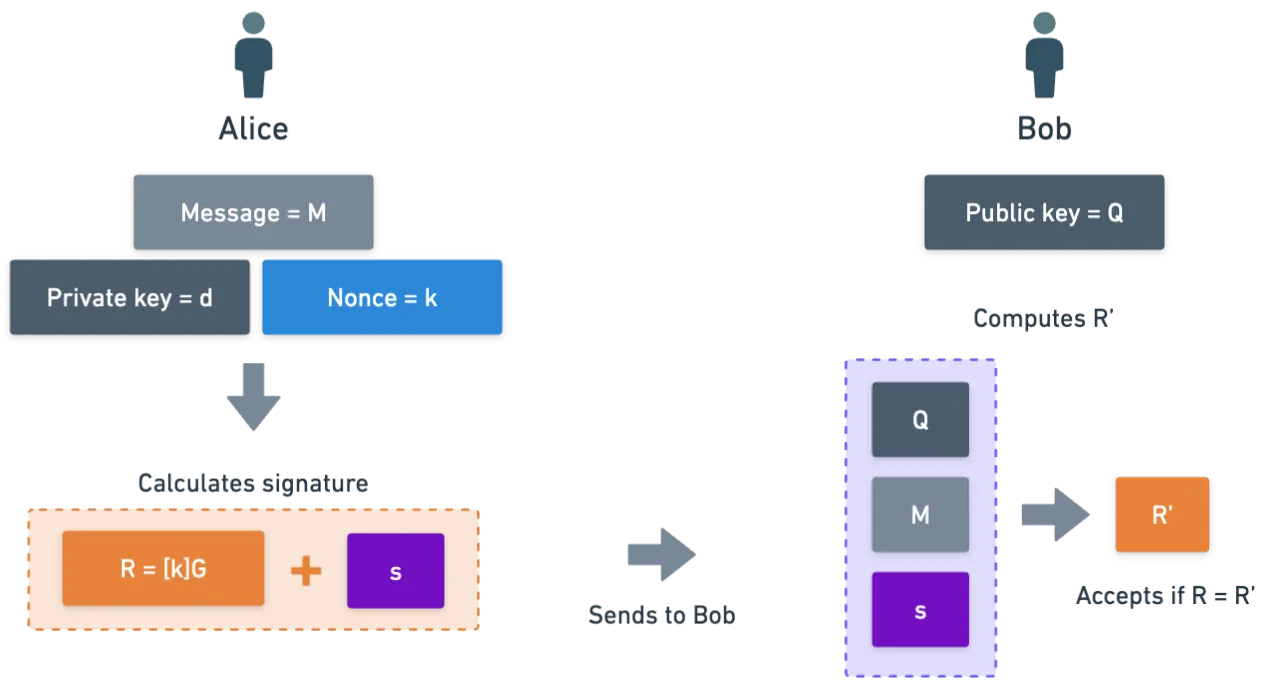
- Bob encodes his message, like he did on the encryption example, but this time the output is an **integer** $M$. We'll see how to do this later.
- Bob then picks a random number $k$, just like in the case of encryption,
- He also calculates $R = [k]G$. We'll denote the x-coordinate of $R$ by the letter $r$,
- The last calculation he performs is for the number $s$, calculated as:
$$
s = k^{-1}(M + d.r) \ \textrm{mod} \ n
$$
- And finally, he sends the pair $(r, s)$ to Alice.
> The $k^{-1}$ in the calculation of $s$ is **not** the **reciprocal** of $k$ (this is, it's not $1/k$).
>
> Instead, $k^{-1}$ represents the [modular multiplicative inverse](https://en.wikipedia.org/wiki/Modular_multiplicative_inverse). Essentially, it's a number such that, when multiplied by $k$, yields the following result:
$$
k.k^{-1} \ \textrm{mod} \ n = 1
$$
> Also, the modulo (n) is a special number: it's the order of the generator point $G$. Every point in the elliptic curve has an order, which is the smallest integer for which $[n]G = \mathcal{O}$. This is also the order of the group $\mathbb{G}$.
Okay, that was a mouthful, but we have our signature. All that remains is **verifying it**. Since the message is public, Bob can **encode** it to the same number $M$ that Alice used. And then, he follows through these steps:
- He calculates $w$ as the modular inverse of $s$, so $w = s^{-1} \ \textrm{mod} \ n$.
- Bob then takes this value and calculates $R' = [w.M]G + [w.r]Q$.
- He accepts the signature if the x-coordinate of $R'$ matches the value $r$.
Working out the numbers and checking that $R' = R$ is a nice exercise for the reader. If you're going to try, just remember that since $G$ is a generator of order n, then $[n]G = \mathcal{O}$. You may also need to use some [modular arithmetic properties](https://en.wikipedia.org/wiki/Modular_arithmetic#:~:text=.-,Basic%20properties,-%5Bedit%5D).
And again, just like magic, a signature is really just a **pair of numbers**! The idea here is that calculating s is really easy with knowledge of the private key, but really hard without it - you'd have to solve a DLP problem!
If Charlie wants to change the message, he has no other option than **brute force**. And we know how that plays out for him (spoiler: it's not gonna be fun).
Let's say this again, so that it sticks:
> Signing involves calculating a sort of "challenge" $R$, and some "verification key" $s$. The pair $(R, s)$ constitutes a signature.
> The value $s$ is special because, when put into a blender (i.e. some process) along with the public key $Q$, and the original message $M$, it yields back the challenge $R$. And the idea is that $s$ can only be calculated with knowledge of the private key.
---
## Summary
There are several more techniques and constructions that we'll be exploring in the next few articles, but this is a good place to stop for now.
I believe it's not as important to understand every piece of math or every calculation at play, but to appreciate how in the end, both encryption and digital signing really amount to a clever use of elliptic curve operations, leveraging the power of the DLP problem.
The good news is that there's a lot we can do with the tools we have so far. More sophisticated techniques will require the introduction of some new and more complex concepts - and we'll not go there yet.
Moreover, there are some things we haven't quite explained yet, like how to **turn a message into a number**, in the case of digital signatures, nor how to **obtain a mask from a point in the elliptic curve**, in the case of encryption.
This can be done via **hashing**, a very powerful tool which will be the central topic of the [next article](https://arkana.blog/en/blog/cryptography-101/hashing)!